





Not your classic mix

Oil once had its place in the Twin Ports, but today the Lakehead Pipeline dock is (choose one)
1.) an anachronism
2.) a misnomer
3.) both of the above

The names of roads, buildings, docks and workboats can tell us a great deal about our maritime community. In many instances, the association of a name with a location, or maritime activity, is the lone remaining connection to our past.

Preserving history and heritage in an active, working harbor, isn't a conscientious process, yet it is surprising how many dock operators and harbor workers hand down their histories and traditions in day-to-day conversations. Over time, as fact and myth intertwine to become reality, we have to be careful to keep truth sorted from fiction.

So, what's in a name, you ask? Recent winter lay-ups at Superior's Lakehead Pipeline Dock provide an excellent example of how the name of a dock can live on, long after the activity associated with the name has vanished.

There is a long held belief that water and oil don't mix. In truth, it is really more of a myth than a belief. Since the Chinese first began shipping oil in wooden barrels, centuries ago, to today's double-hulled super carriers plying the high seas, oil and water have become synonymous in the transportation of liquid bulk cargoes.

The movement of oil on the Great Lakes, and their adjoining waterways, began in Cleveland when the Standard Oil Company established operations along the Cuyahoga River in the 1860s. On the Canadian side of the lakes, the Imperial Oil Company, established in 1880, began using the waters of the Great Lakes to supply its refinery operations at Sarnia, Ontario, in 1899.

A half-century later, the port of Superior would play an integral role in linking the refinery operations at Sarnia, via pipeline and tankers, with the developing oil fields of western Alberta. Like the pipeline itself, connecting the interrelated parts and players is complex, and detailed. In 1951, the Lakehead Pipeline Company was formed. It was a subsidiary of the Interprovincial Pipe Line Company, of which Imperial Oil was a major stakeholder. Lakehead Pipeline was organized to operate the 324-mile portion of the line inside the United States, as well as the new terminal being built at Superior.

At the time of its construction, the pipeline was hailed as a great engineering achievement. Construction began in the summer of 1950, quickly compiling facts and figures to certify its claim to greatness. More than 1,500 men were employed, laying successive sections of 20-inch, 16-inch and 18-inch pipe across 1,000-plus miles of provincial and state property in a scant 150 days.

In anticipation of an initial intake of 55,000 barrels of crude a day into Superior, the pipeline's eastern terminus, a tank farm was constructed. It had 12 storage tanks with a capacity of 150,000 barrels of oil (6.3 million gallons), with additional storage planned for the future.

The final two miles, from the tank farm to the loading dock, completed the oil to water connection between Edmonton, Superior and Sarnia. On Aug. 25, 1950, the first oil left Redwater, Alberta, on its thousand-mile journey to Superior and the new dock.

Simultaneous plans were developed to provide adequate tanker capacity, resulting in the construction of four new tankers. On Nov. 4, 1950, the Imperial LeDuc hit the water at Collingwood, and two weeks later, on Nov. 18, the Imperial Redwater was launched at Port Arthur. The Imperial Woodbend and the B. A. Peerless soon followed.

Each tanker had a capacity of 120,000 barrels (at a 24-foot draft), compared to the smaller tankers, with capacities in the range of 20,000 to 52,000 barrels, most common on the Great Lakes. The large tankers, custom built for this endeavor, were 620-feet in length with a 68-foot beam. The new tankers were powerful, their steam-powered engines capable of generating 4,500 shaft horse power, with a top speed of 15.5 knots, rivaling the speed of any vessel on the lakes. The average turnaround for each trip was four days from Sarnia to Superior.

While the new tankers were the talk of the town, coming fresh from their respective shipyards, the honor of the first load from the Lakehead Pipeline dock went to an older tanker, the Makaweli, under charter to Imperial Oil Company, by Lakeland Tankers, Ltd., of Toronto. The Makaweli, in spite of its near-mid night arrival, attracted a generous crowd of officials and well-wishers to inaugurate the loading facility.

The pipeline and the shipping facility enjoyed immediate success. In its first season, 161 vessels called at the Lakehead Pipeline dock, carrying some 13 million barrels of crude. The following season, 1952, nearly 20 million barrels of crude were delivered from the Superior facility to Sarnia, as well as the port of Clarkson, on Lake Ontario. During its second season the Lakehead Pipeline dock was loading an average of one vessel a day, an impressive feat for any bulk cargo dock on the Great Lakes.

As the need for western oil continued to grow, the weather-shortened shipping season on the Great Lakes had a lethal influence on the long-term viability of the Lakehead Pipeline dock. To satisfy customer demand, an uninterrupted flow of crude from the Alberta oil fields to the Great Lakes refineries was paramount.

In May 1953, with the traditional lake's shipping season just underway, Interprovincial awarded contracts for the extension of the pipeline from Superior to Sarnia. When completed, the total length of the pipeline would extend to 1,765 miles, the longest in the world.

The extension of the pipeline meant the end of the line for Superior's Lakehead Pipeline dock. By November 1953, the large "Imperial" tankers were discharging their last cargoes of crude at Sarnia. The short-term boom was over for the tanker fleet, and the Superior dock. The tankers were quickly sold and converted into more traditional bulk carriers to continue their useful lives on the lakes.

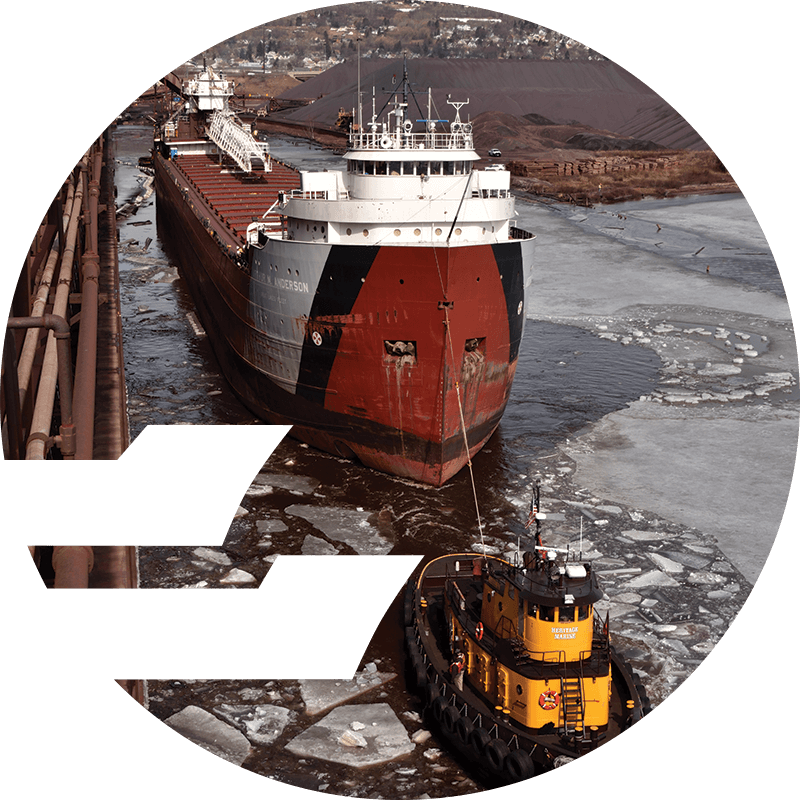
Since the late 1950s, the Lakehead Pipeline dock at Superior has remained largely unoccupied, yet it continues to hold on to the heritage derived from its name.

For the record, this dock has been a coal dock, a scrap dock and a fuel dock. At the opening of the Seaway, it hosted several visiting naval vessels, drawing large crowds to the once busy dock. In recent years, the 1,100-foot long pipeline dock, once capable of berthing two tankers, has become a comfortable winter lay-up home for bulk carriers, somewhat ironically, making use of the dock during the winter months that were largely to blame for its demise as a tanker dock.

Pat Lapinski, a native of Superior, Wisconsin, is a writer and photographer who concentrates on the Great Lakes maritime industry. Visit: www.inlandmariners.com